Long COVID is not what you think it is, but that’s a good thing
Apr 08, 2026
If you have long COVID, you already know your symptoms are real.
You don't need me or anyone else to tell you that. You've been living it. You know what it feels like to wake up exhausted after ten hours of sleep, to lose a word mid-sentence, to do something ordinary and spend the next three days paying for it. You've felt it in your body. You know.
What a lot of people with long COVID don't have is a clear explanation for why it's happening and a care team that both believes them and has something useful to offer.
That's what I want to talk about in this post. Not to convince you or anyone else your symptoms are real. That's not up for debate. But to offer a framework for what's driving them; one that holds up both scientifically and practically, and to be honest about what working with me actually looks like.
First, a Word About Being Dismissed
Before I get into the science, I want to name something that I hear from almost every long COVID client I work with.
At some point (usually multiple points) they were dismissed. Sometimes it was a doctor who looked at a normal blood panel and concluded there was nothing to investigate. Sometimes it was a comment from a family member who thought they should be better by now. Sometimes it was more subtle — an implication that the symptoms were stress-related, or that they needed to push through them, or that the illness was somehow connected to how they were coping emotionally.
That experience of being dismissed, minimized, or indirectly blamed has a name. It's gaslighting. And it does real damage.
Through my background is in physiology and physiotherapy, I've spent years in research and clinical practice and what I've come to understand is that chronic pain, stress, and persistent symptoms are not "just in your head" or "all in your body" — they're a complex interplay. That complexity doesn't make your symptoms less real. It just means the explanation requires more than a standard blood test.
If someone has told you otherwise — that's a failure of the explanation, not a failure of your body.
What Is Actually Happening
Here's the framework I work from, and I want to be clear about what it is and what it isn't.
For a significant number of people with long COVID, the primary driver of symptoms is not ongoing structural damage in the tissues. It's a nervous system that has been genuinely dysregulated and stayed that way.
Now, I want to be careful about how I say that — because I know exactly what it can sound like. It can sound like: the problem is in your head, not your body. That is not what I mean. Not even close.
And here is why it’s so confusing! Many people with Long COVID get lab results that look genuinely concerning, and it’s important to say clearly: these findings are real. Blood work might show signs of ongoing inflammation, an immune system that looks overactive or worn down, problems with blood flow or tiny clots, lower energy production at a cellular level, reactivated viruses like mono, or markers linked to brain fog, fatigue, and poor healing. When you see results like these, it makes total sense to try to fix each one individually—calming inflammation, thinning the blood, boosting immunity, treating mast cells, supporting mitochondria, or treating viral reactivation. But for many people, this becomes an exhausting game of whack‑a‑mole that doesn’t even touch most symptoms, let alone resolve them. That’s because these lab changes are often not separate problems by themselves—they are signals of a nervous system stuck in high alert, constantly scanning for danger after the infection. When the brain believes the body is still under threat, it shifts everything into protection mode: energy is conserved, blood flow changes, inflammation stays switched on, digestion and repair slow down, and immune signaling becomes distorted. These lab abnormalities are how that protective shutdown shows up on tests. Until the nervous system learns that the threat has passed and it is safe again, the body keeps expressing the same patterns—no matter how many individual numbers you try to fix.
At the same time, it’s essential to respect what these findings represent and respond to them wisely. Even if these lab changes are driven by a nervous system stuck in protection mode, they still reflect a body that is under strain and needs care—not pushing, fixing, or forcing. This is why pacing becomes so important. Ignoring limits or trying to “power through” symptoms often leads to the familiar boom‑and‑bust cycle: doing too much on a better day, followed by a crash that reinforces the body’s sense that something is wrong. Thoughtful pacing—staying within energy limits, spreading activity out, and allowing regular rest—helps signal safety to the nervous system while reducing symptom flares. These strategies are not about giving in to illness, but about creating the stable, predictable environment the nervous system needs to stand down from high alert. When pacing and symptom respect are combined with approaches that directly address nervous system hypervigilance, recovery becomes far more likely. You are not ignoring the labs—you are working with your biology, supporting the body while teaching it that it is safe to move out of survival mode and back toward health.
We have to remember that the nervous system is a physical system. And when it gets dysregulated, it produces completely real, physical symptoms. Fatigue. Pain. Brain fog. Heart rate irregularities. Sensitivity to light, sound, and movement. These are not imagined. They are the output of a system that is genuinely running way too hot than it should.
Think of it this way. Your nervous system — and specifically the autonomic nervous system, which runs most of your body's background functions — has two main modes. One is alert and activated. One is calm and restorative. Normally, it moves between those modes in a flexible, healthy way.
After a significant illness, that flexibility can be disrupted. The system can get stuck in the alert, activated state. It keeps scanning for threat. It keeps running emergency protocols. And it produces symptoms — physical, real symptoms — that reflect the fact that it's been in that state for too long.
That's not something you’ve done wrong. It's not anxiety, in the common sense of the word. It's a physiological pattern that developed in response to a real event — the illness — and hasn't resolved the way it was supposed to.
The reason this framing matters isn't to give you a better way to think about your situation. It's because understanding the actual driver is what allows you to find the right approach. If the primary problem were structural damage in the tissues, the treatment would look one way. If the primary problem is a dysregulated nervous system, it looks quite different. And in my clinical experience, for most of the long COVID clients I work with, it's the second one.
Post-Exertional Malaise
I want to spend some real time on this, because I think post-exertional malaise is the most misunderstood and most often mismanaged feature of long COVID.
Post-exertional malaise, or PEM, is not just being tired after activity. I want to say that again, because it's important: PEM is not ordinary fatigue. It is a significant, often system-wide worsening of symptoms like pain, brain fog, immune symptoms, cognitive disruption, and more that follows physical or mental exertion that the body cannot currently handle.
It has a distinctive feature that makes it particularly difficult to navigate: the crash is often delayed. You do something, feel okay in the moment, and then several hours later — or the next day — your system collapses. That delay makes it genuinely hard to connect cause and effect, both for you and for the people around you.
I've spent time in long COVID research, and PEM is one of the things I take most seriously in this space. It's a physiological response — the nervous system and immune system reacting to a load they genuinely cannot manage right now. It is not deconditioning. It is not a mental block. And it is not something that responds well to being pushed through.
This is where I want to be very direct: if you are experiencing PEM, a graded exercise program is not the right approach. I know that's a common thing people get referred to. And for many conditions, it's appropriate. But with PEM, progressively increasing activity load tends to trigger setbacks — sometimes significant ones. The evidence on this is clear enough, and the lived experience of long COVID people is even clearer.
The approach that tends to work is the opposite of grading up. It involves finding a safe, non-confrontational way to help the nervous system settle into a solid foundation of consistent activity — not forcing it, but working with it gently. Finding the level of activity your system can handle without triggering a crash. Staying comfortably within that level — not at the edge of it. And building very slowly, from a place of stability rather than a place of push.
Mental and emotional exertion count just as much as physical exertion here. A hard conversation, a stressful decision, a long and demanding meeting — these draw from the same reserves. Pacing applies to all of it.
Learning to Notice Sensations Without Fear
One of the more counterintuitive things I work on with long COVID clients is the relationship between attention and symptoms.
When your body has been producing alarming symptoms for a long time, it's natural to develop a vigilant relationship with those sensations. You monitor them. You try to figure out what they mean. You notice every change, every fluctuation, every sign of a potential crash. That monitoring isn't irrational — it developed because something genuinely went wrong, and staying alert felt like the only way to manage it.
The problem is that a nervous system that is already in a heightened, threat-detecting state doesn't respond well to being watched closely for danger. Pain Reprocessing Therapy (one of the approaches I use) works on exactly this: teaching the nervous system to stop interpreting normal or benign sensations as dangerous. Over time, the relationship with physical sensations can shift from alarm and bracing to something more like curiosity and neutrality.
This isn't about ignoring symptoms. It's not about positive thinking or telling yourself everything is fine when it isn't. It's about changing the relationship — from one that reinforces the threat response to one that begins to quiet it.
Part of this is the intention behind what you're doing. Doing things for enjoyment because something feels good and because you want to tends to produce a different result than doing things specifically to try to get rid of symptoms. The nervous system picks up on that difference. It may sound subtle, but in practice it tends to matter.
How Emotions Can Show Up as Physical Symptoms — And Why That's Not Your Fault
This is probably the section that requires the most care, so I want to lead with what I'm not saying.
I'm not saying your long COVID symptoms are caused by emotions. I'm not saying you'd feel better if you just dealt with your stress. I'm not saying this is psychological rather than physical. I’m not saying mindfulness meditation is the way forward or that you can somehow talk your way out of your symptoms.
What I am saying is that the nervous system — the same system I've been describing throughout this post — is also the system that processes emotions. Fear, grief, frustration, anger, and prolonged stress all run through the same hardware. And when that hardware is already dysregulated, the influence can go in both directions: unprocessed emotional load can affect how symptoms behave. Not because the emotions are causing the illness, but because the body and mind are deeply connected and grief, fear, and stress move through both.
What I've noticed clinically is that when people can begin to identify what they're carrying emotionally — the fear about whether they'll recover, the grief over what they've lost, the frustration of not being believed — and find ways to express and process that, it sometimes creates a small but meaningful shift in how the body responds. The more connections a person can make between their physical symptoms and the emotional concerns, traumas, or adverse experiences in their life, the more evidence the nervous system seems to gather that it's on the right path.
That's not a prescription. It's an observation. And it doesn't apply the same way for everyone.
What I want to be clear about is this: if emotions are showing up in your body, that's not your fault. It's not a sign that your illness is less real. It's just how the nervous system works — and it's worth knowing about.
What Working With Me Actually Looks Like
I want to be honest here about what I do, what I don't do, and who I work best with.
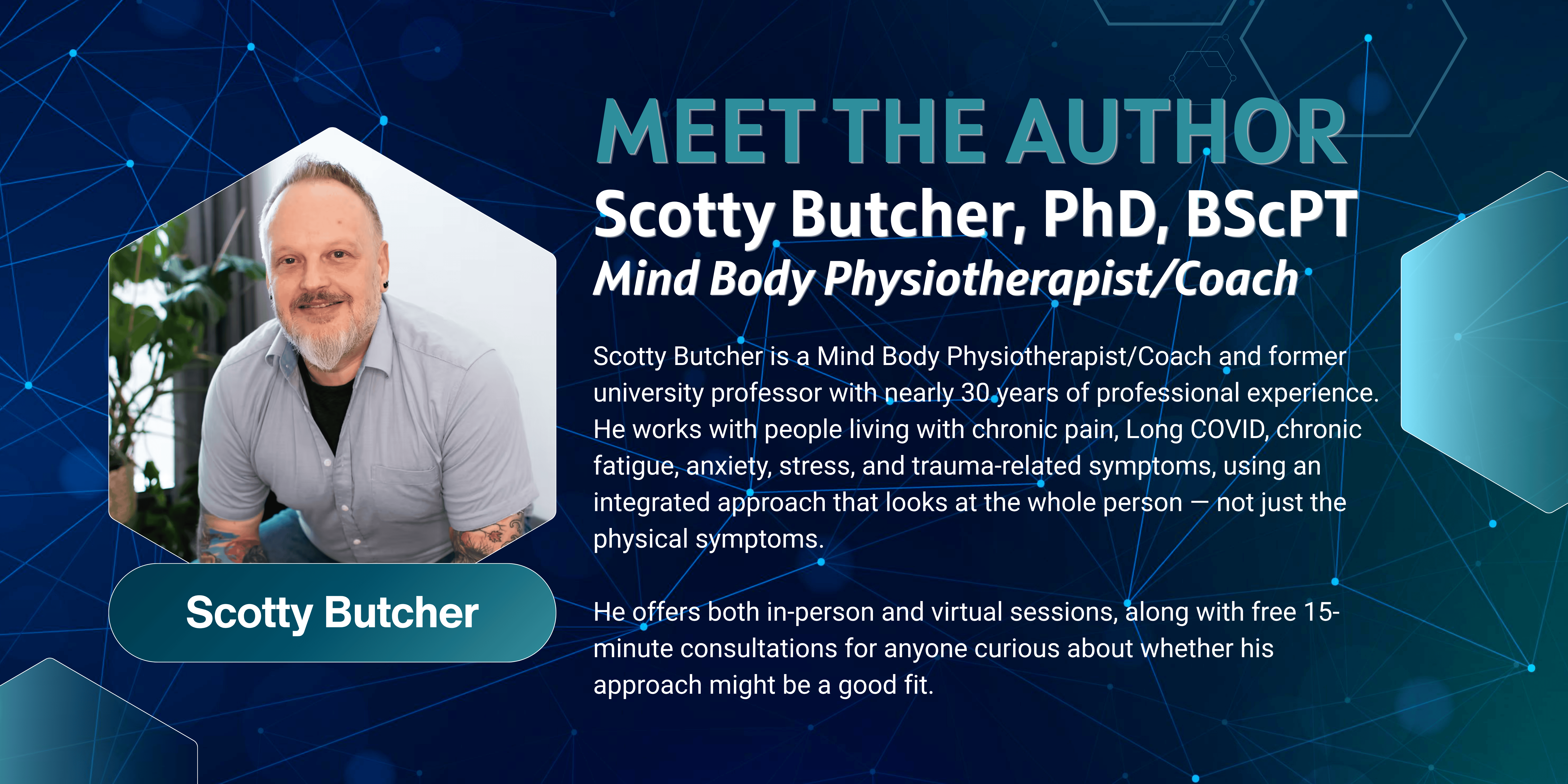
My approach blends my almost 30 years of physiotherapy experience, neuroscience coaching, and mind-body care. The tools I use include many years of continuing education and certifications that make it so I can truly understand you and your story, and help you in a meaningful way. I work both in person in Saskatoon and virtually with clients anywhere.
When someone comes to me with long COVID, the first thing I do is listen. Not to screen them or assess them — to actually understand what they've been through, to hear their story, what they've tried, what's helped even a little, and what's made things worse. That context matters enormously.
From there, the work usually involves a few threads running in parallel. One is specific feedback based on their story — helping people understand what's happening in their nervous system and why their symptoms make sense given that. That shift in understanding often reduces some of the fear around symptoms, which itself has an effect. Another thread is regulation — building practical tools for calming the nervous system, including paced breathing, somatic tracking, and gentle body-based practices that help the system begin to settle. A third thread, when it's appropriate, is exploring the emotional layer — what the person is carrying, how that might be showing up physically, and how you can facilitate releasing some of those stored emotions.
I don't offer a graded exercise program for clients with active PEM. That's not me being cautious — it's me being accurate about what the evidence supports and what I've seen in practice. We will usually address increasing activity at some point, but only after we demonstrate that recovery supports that approach.
I'm also not a psychotherapist or counsellor, and I don't work as one. If what someone needs is primarily psychological support — trauma processing, ongoing mental health care — I refer out to my amazing team. I'm happy to connect with a client's counsellor or therapist if that's helpful, and I think coordinated care tends to produce better outcomes than working in silos. The right team looks different for different people, and I'd rather help someone find the right fit than try to be everything.
The clients I tend to work best with are people who have already done some investigation — who've had the medical workup, who have a reasonable picture of what isn't the problem — and are ready to work on the nervous system piece. People who are willing to go slowly. People who understand that progress in this space often looks quiet and gradual before it starts to look obvious.
A Final Note
Recovery from long COVID is not linear. It often involves setbacks that feel like going backward. It asks for a kind of patience with yourself that most people find genuinely difficult. Especially people who were active, capable, and used to pushing through hard things.
I'm not going to promise outcomes. I'm not going to tell you that what I offer will fix everything. What I can tell you is that I take this seriously, I understand the research, I believe what my clients tell me, and I'll work with you — not at you.
If any of this resonates, I offer a free 15-minute consultation. You can use that time to ask questions, get a feel for whether this approach makes sense for you, and figure out together whether working with me is the right next step.
You've already been through enough guesswork. You deserve a conversation that starts from a place of being believed.